
Find the person
The starting point is familiar: someone calls across the house, nobody hears the answer, and the shouting starts again. A phone might be on silent or charging in another room. Children may not have one at all.
I want Ripple to let someone say “Hey Dad” without needing to know which room Dad is in. Small devices around the home would connect the conversation where he is most likely to be. If the system is unsure, a short summons would let him answer from a nearby device, opening the conversation there and leaving the others quiet.
Listening locally
The proposed design keeps the immediate listening work on the device: detecting a wake word, identifying speech and recognising supported requests with compact models. The aim is a quick response that does not need a cloud round trip for every conversation.
Cloud assistance has a different role. With permission, selected recordings can help build reviewed training examples for names and household phrases. Recognising a request, identifying the speaker and locating the recipient are separate problems; a transcript alone does not solve all three.
Where to connect
I’m exploring how recent recognised speech and opt-in Bluetooth proximity could help estimate where someone is. Those signals need a sense of freshness and confidence: a phone left on a table is not proof that its owner is still beside it.
That uncertainty needs to shape the behaviour. Asking someone to answer a summons is better than confidently connecting the wrong room. Longer term, optional telephone calling could extend the same idea beyond the house. Clear call indicators, microphone controls and household preferences are part of the intended design.
Early experiments
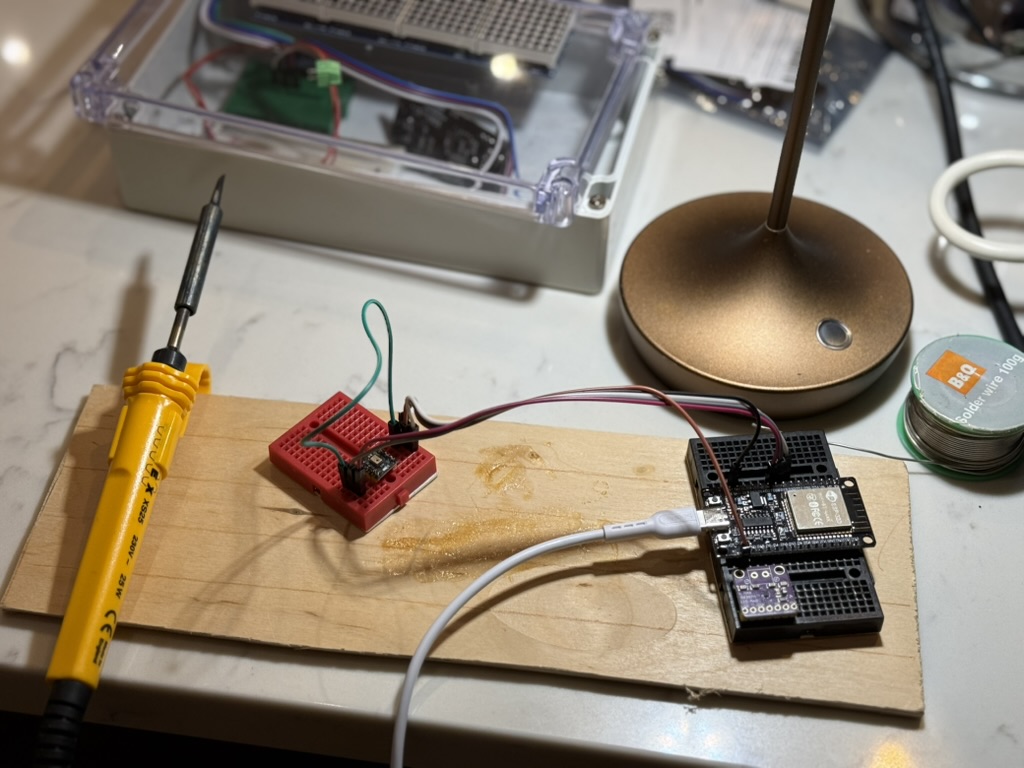
Ripple is still very much a work in progress. So far, I’ve been testing microphone capture and SIP/RTP audio on ESP32 hardware, alongside a separate wake-word detector and cloud transcription workflow. The photo shows the initial wake-word experiments.
The next challenge is bringing those pieces together. Reliable two-way audio, speaker recognition and routing to the right person all need to be proved in a real home, with television, background noise and competing voices. The ambition is a simple everyday interaction; the current work is understanding what it takes to make that dependable.